
On the Edge
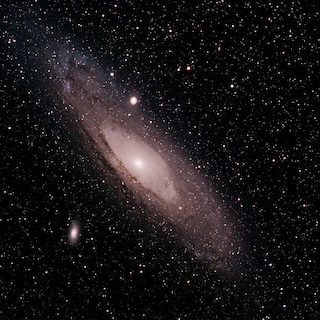
The solar system, their world before their departure, was on the edge of their galaxy, the “Milky Way”. Little Andromeda’s system and double star were also on the edge of the neighbour galaxy, Andromeda. It happened that there was a line of sight in space time, from one to the other. To seek why this was the case was one of the reasons for Paul’s and Agnes’ mission there. This line of sight meant that travelling there, through a thin relativistic tunnel, took a few years, rather than decades. However the tunnel was not always open. There had been much speculation on the astro-physical rationale for it. Still, the problem of telecommunications, even at those speeds, subsisted. The volume of scientific data that the mission had to send back to Earth, even after pre-processing and compression, remained a challenge.
Simplification
After their morning exercises and duties, Paul and Agnes worked on a programme to optimise further the data collection, and reduce the time, and thus costs, of transmission. This was one of several software projects Agnes and Paul were responsible for.
Agnes’ coding skills and speed were superlative. Yet it was Paul who often worked out the shortcuts, the simplification. They worked together well, another reason they had been paired for the mission. Their work place was contiguous to their personal quarters, and to the small gym. It was now full of colourful plants and bookshelves. Originally this “study” had been the provisional accommodation, that Hans had built before they could start the construction of the dome.
Building
Paul remembered the months that followed their arrival. Their transport had approached the planet, positioned itself on a low geostationary orbit, as remote probes and sensors started analysing the atmosphere, the geological composition of the landscape they could soon see by themselves. At the end of the voyage, Agnes and Hans were awake long before Paul, whose exit from the catalepsy of space travel took several weeks. Agnes looked after him days and nights, while Hans travelled back and forth with the shuttle, bringing to the ground the material for their shelter, and more sensing equipment. It was two years past. The building of the dome to its present state, had taken one year.
Now, every day, they worked on a programme for three or four hours, then took a break, and switched to the more practical hands-on work on their agronomic and geophysics experiments. The artificial night, under the dome, was adjusted according to seasons, longer during winter, the shortest in summer. They had engineered a little moon, that crossed the nightly sky. Most days, Hans worked on the dome, its maintenance, and improvements to the climate control and sensors network. His work was also to prepare for an expedition around the planet which was part of their mission. For this, the shuttle would be modified into a “rover” capable of negotiating the rough terrain of the surface of Little Andromeda. From sensors data, and films made by the multiple cameras aboard their transport, Paul was working out the possible itineraries for the exploration, but this was still months away.
Spartan
In the evening the three of them met for a light meal. Hans’ sobriety was proverbial. Agnes called him a “mean Spartan”, which was not meant in an unkind manner. They then told each other of their work, what they may have discovered, how they felt about the mission. That evening Paul said his dreams about Dakar had for now stopped. Hans had been interested to know, since Paul had said he too was in the dream, what his job was there. Afterwards they listened to a concert by the Berlin Philharmoniker, out of the huge musical library. It was usual for Hans to retire first. His nights were short, and he was often already at work, outside the dome, by the time Paul and Agnes emerged.
Leave a Reply