
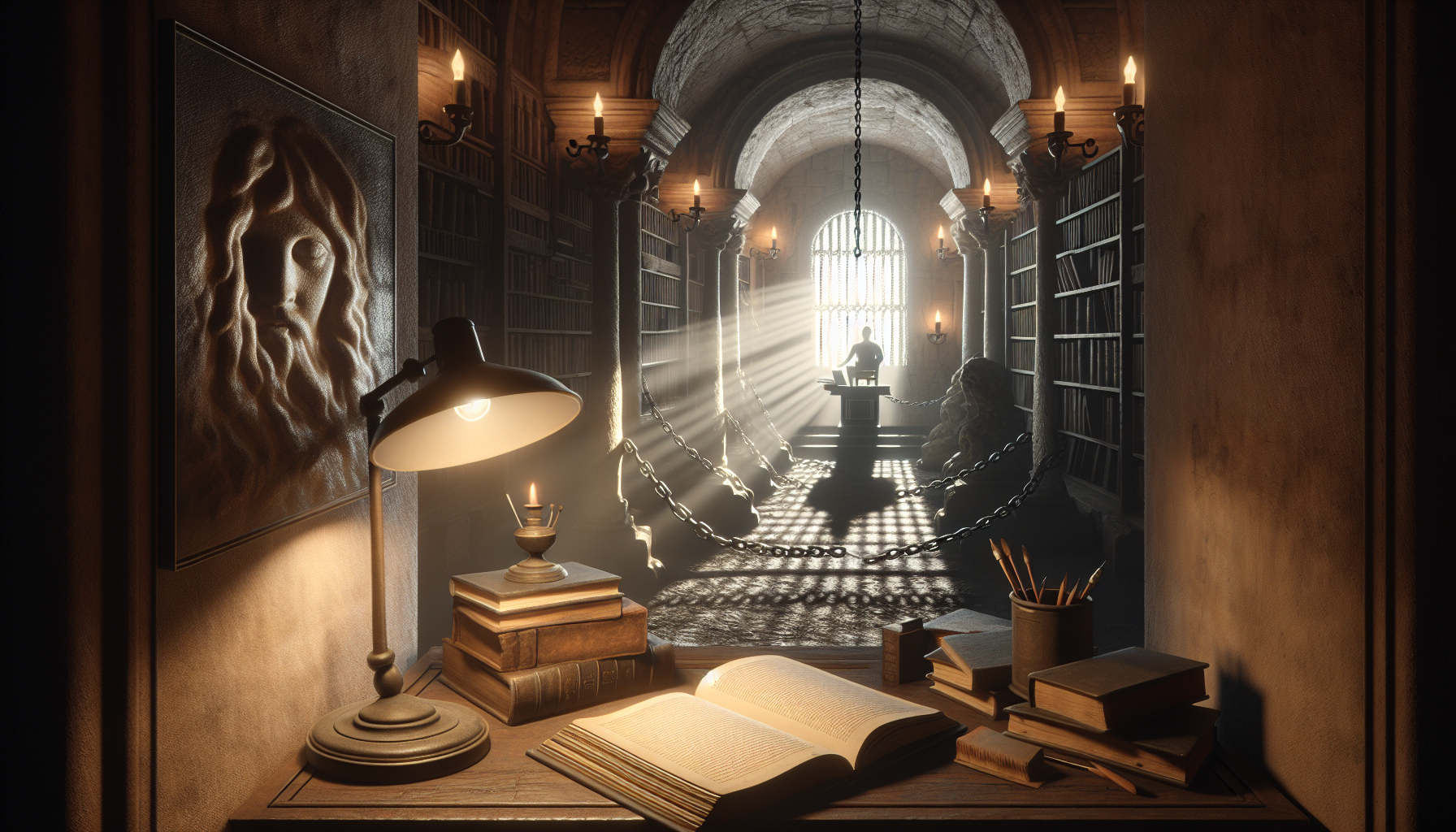


Picture: “Socrates: And now look again, and see what will naturally follow if the prisoners are released and disabused of their error. At first, when any of them is liberated and compelled suddenly to stand up and turn his neck round and walk and look towards the light, he will have pains; the glare will distress him, and he will be unable to see the realities of which in his former state he had seen the shadows; and then conceive some one saying to him, that what he saw before was an illusion, but that now, when he is approaching nearer to being and his eye is turned towards more real existence, he has a clearer vision, —
what will be his reply? And you may further imagine that his instructor is pointing to the objects as they pass and requiring him to name them, —will he not be perplexed? Will he not fancy that the shadows which he formerly saw are truer than the objects which are now shown to him? ” — From Book VII of Plato’s Republic, 380 BC
Silent contemplation: I seek advice only from the written word
Silence is Gold. If not from my living partner, I seek advice almost only from the written word, from authors or books in the timeline of antiquity to today. I am a slow reader/learner, and tend to read work several times, over years. I do not differentiate between philosophy, history and fiction, as I am convinced that the form is of little consequence. Most of the authors or works listed here are old acquaintances, and a few more recent ones like Ilyin. I am only fluent in two languages, although I can read German at a slower pace. I regret not being able to read Russian in original.
Then, Classics in Silence
The New Testament: Matthew, Jesus is King. Silence in prayers.
Sun Tzu: the author of “Art of War”, perhaps a collective. This work is not only about war, but also about personal conduct, in fact a way of life.
Plato: he exposed the fallacy of shadows, as opposed to the reality in bright sunlight. His allegory of the cave is key to understanding our present predicament: the lies, the stupor of a good many of our contemporaries.
“Hagakure”: not an author but a précis of the way of the Samurai (Bushido). This ancient text is about personal morale, loyalty, austere standing in facing death. Silence and concentration.
Montaigne: he wrote his “Essays” from the midst of the hideous religious wars in southern France, at the time Henri de Navarre was about to become Henri IV. He sought peace and silence in his family house, away from the turmoil of war.
Byron: the immortal poet of the liberation of Greece, and many other heroic deeds.
Stendhal (Henry Beyle): La Chartreuse de Parme, Le Rouge et le Noir, early loves, the Italian dream.
Baudelaire: one of my teenage loves, who taught me about Poe, and the futility of love.
Edgar Poe: the master, the magician of thresholds, of the dream world, of the inevitable failure of beauty. Mask of the Red Death: indeed.
Dumas père: his masterpiece is the Vicomte de Bragelonne, between history (he also wrote a historical account of the Siècle of Louis XIV) and fiction. This is a vast panorama, using characters of the Trois Mousquetaires, of the beginning of the reign of Louis XIV. A serious book which is also very good fun.
Now/contemporary: End of Silence
Oswald Spengler: the analyst of the decline of the West. Rereading him is timely, as we hear every day. He thought after meeting him, that Hitler was an idiot.
Ivan Iliyn: a recent encounter. Philosopher and historian, white (anti bolshevik/communist) noble and officer, who sought refuge form both the Trotskyites and the Nazis in Switzerland, helped by Rachmaninov.
Marcel Proust: the only (bar one) writer who really gave us a story of his life, from a room in Paris. A summation of much of French literature till then, and a ghost of the first World War
Albert Camus: L’Homme Révolté, or the myth of Sisyphus. Another teenage love. I kiss him so much. His love of Algeria, the beauty of olive groves, the sea, the tragedy of the war, and La Peste, the double mirror of the plague in Oran, and French fascism.
Thomas Pynchon: Gravity’s Rainbow, WWII, the Manhattan project, the sand of Los Alamos…
“Q”: from the Italian collective now named Wu Ming, not so silent odyssey of a hero and a spy, from the onset of the Reformation, through the Peasants Revolt to the slaughter of the Anabaptists and the dawn of the Thirty-Year War, a masterpiece.
Giovanni Arrighi: Italian economist, The Long Twentieth Century: why the rise and fall of “great powers”. His work is more relevant than ever: to be read in deep silent concentration, with Hudson the anti-liberal economic remedy.
Michael Hudson: the dragon slayer of lunatic neoliberalism, economist and financial historian, the rise of the rentier class in Antiquity, and key to the current oligarchic hold on the West (and beyond). The Destiny of Civilisation, The Collapse of Antiquity: debt and the killing of the kings (how it all started).
Not silent others
In conclusion, the written word has always been my trusted source of advice and guidance. Whether it be the wisdom of ancient philosophers, the lessons of history, or the imaginative tales of fiction, I have found solace and enlightenment in the pages of literature. Silence is indeed golden, and in a world filled with noise and opinions, I have discovered that the written word possesses a unique power to speak to my soul. As a slow reader and learner, I have embraced the practice of revisiting works over the years, allowing their messages to sink in and shape my understanding of life. Philosophy, history, and fiction intertwine seamlessly in my pursuit of knowledge, as I believe that the form of expression matters little when it comes to the profound impact it can have on our lives. So, let us continue to seek advice from the timeless voices of literature and history, for within their words lie the keys to our own personal growth and enlightenment.
Also: Lovecraft, master of dreams, Carl Schmitt… I have only so far mentioned written work and authors, but there is also music: to be enjoyed silently, Bach, Vivaldi, Mozart, Beethoven, the great Russians, especially Rachmaninov, Brahms… The topic for another post.


Leave a Reply