
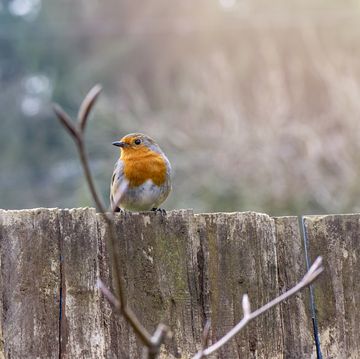


Why build a fence?
My most ambitious project, continuing to this day, was to build a fence. But not just any sort of fence. This one would be special. Our house has an “L” shaped garden open to a small wood that borders this group of five or six houses. Our neighbours all have wooden fencing, high enough to keep dogs and cats in, but not a real obstacles for the foxes that abound in this neighbourhood due to a large area of heathland that survived the building of several highways.
We wanted to keep access to the woods open, but not so open as to invite those foxes to invade the garden as pleased them. The fence would have to be friendly to all animals, no barbed wire here, and ecological, using the natural growth of holy and other bushes. A previous owner had started a line of soft fencing, not high enough to stop anything, and not on the whole length of the garden. So the first step was to reuse what was already there, strengthen the existing wire fence and build it up.
Soon we realised this project was not a easy as it may have appeared at first look. The ground is on a slope, and very sandy. Ivy is present everywhere which does not facilitate planting anything new. There is also a fair amount of old metal, remnants of an old railway track that used to service a nearby quarry. So the project soon grew in scope, as demanded by our discoveries.
Material for a fence
We were determined not to use anything that could harm anyone, friends or foes. This excluded sharp metal, breakable glass, and generally anything that would resist recycling. We trimmed the existing bushes, laid down new soft fencing where there was none, used mesh wire to discourage those foxes. The latter was sweetly illusory as those creatures can’t care less.
So we started invested in other, non lethal methods, such as ultrasonic posts that are supposed to keep them away. This was moderately successful. We tried also some flashing light that are triggered by motion at night. The level of light pollution is high in our neighbourhood, as people have elected to line up their gardens with solar electric bulbs! We did not want to aggravate that situation.
We decided to double the fence, expecting that two rows of obstacles would be more convincing than a single one. At this point we realised that our fence would be worth its weight in silver very soon, as building material of that sort is not cheap. However we persevered. After a couple of years it looked better, although still very amateurish, compared with the geometrical perfection of wooden fencing. However we have retained our access to the woodland, the wild fauna are happy crossing the garden on their way elsewhere (we suspect some of our neighbours feed them), and the only maintenance cost is to change the batteries of the ultrasound sensors, about every five or six months.
A fence: a never ending project
We have learnt a few lessons from this project: first a natural, or near natural fence, more or less maintains itself, as opposed to a length of wooden fencing with needs replacement every so often. Second, wild life is not bothered, coming and going more or less as they wish, generally a good thing, since the wildest creatures we see are foxes, hopefully disease-free. Third our neighbours see us as softly crazy, but inoffensive. None of this is problematic.
Compared with other projects we have completed, this one is never going to be finished, always a bit of repair here and there, and of course the mesh gets pulled off, and things grow! It may not be as satisfactory as building a loft extension, or a porch, or a bicycle from spare parts, but it is part of messing about in the garden, an endless pleasure
Picture: https://www.countryliving.com/uk/wildlife/countryside/a20881008/rare-wild-animals-see-uk/
Leave a Reply