

For a brief instant there was peace, a glimpse of what had been long ago, before the fall. Rome was still close, it seemed. But the truth was it would disappear again, another long night would hide the splendour.
Cultural splendour
Cultural splendour, what makes certain civilisations shine above others, arises from Faith and Spiritual strength, that is the view of human beings made in the Creator’s image, and so it was for the Eastern Roman Empire, Constantinople, before its destruction by the evil Venetians. Ghostly reflections of its glory are still visible today, in the dim light of what Spengler called the West’s decline. Some of the brilliance, with a touch of western austerity, subsisted briefly in medieval times, under Charlemagne, Karl Der Große, and his capital of Aix, Aachen.
Byzantine Splendour
It is the blend of medieval fervour, associated with the recollection of the Byzantine splendour, that made those few decades the apex of Carolingian Europe, how and why this crumbled is a matter of importance to understanding what led to the long night of Christiandom and to our present.
Robert Ingraham wrote in “The Modern Anglo-Dutch Empire”: “All of the recorded human history encompasses a centuries-long fight between those who view man as a noble creature, as Genesis says: ‘made in the Creator’s image’, versus the oligarchic view of man as a beast, expendable, a ‘worthless wretch’. All human progress has emanated from the champions of the first view, empires result from the proponents of the second view.”
Venice and War
Ingraham’s book follows the logic of history, from the fall of the western Roman empire to the betrayal of Constantinople, and on to the creation of the “Venetian system”. He quotes Bertrand Russell, from “The Impact of Science on Society” (1952):
“At present the population of the world is increasing… War so far has had no great effect on this increase… I do not pretend that birth control is the only way in which population can be kept from increasing. There are others… If a Black Deathcould be spread throughout the world once in every generation, survivors could procreate freely without making the world too full… the state of affairs might be somewhat unpleasant, but what of it? Really high-minded people are indifferent to suffering, especially that of others.”
And contrast Russell’s statement with that of John Robinson, Pastor of the Plymouth (Pilgrim) Church, “Of Faith, Hope, and Love, Reason and Sense”:
“Reason is that wherein man goes before all other earthly creatures and comes after God only… For whereas God and nature hath furnished other creatures, some with hoofs, others with other instruments, and weapons both defensive and offensive, man is left naked, and destitute of all these, but may comfort himself in that one endowment of reason, and providence, whereby he is able to govern them all.”
Harmony
Another quote, from Henry C Carey, the foremost American economist of the mid-to-late 19th century, demonstrates this difference ‘in an historical specific way’:
“Two systems are before the world… One looks to pauperism, ignorance, depopulation, and barbarism, the other to increasing wealth, comfort, intelligence, combination of action, and civilisation. One looks toward universal war, the other to universal peace. One is the English system; the other we may be proud to call the American system, for it is the only one ever devised, the tendency of which was that of elevating while equalising the condition of man throughout the world.” The Harmony of Interest (1851)
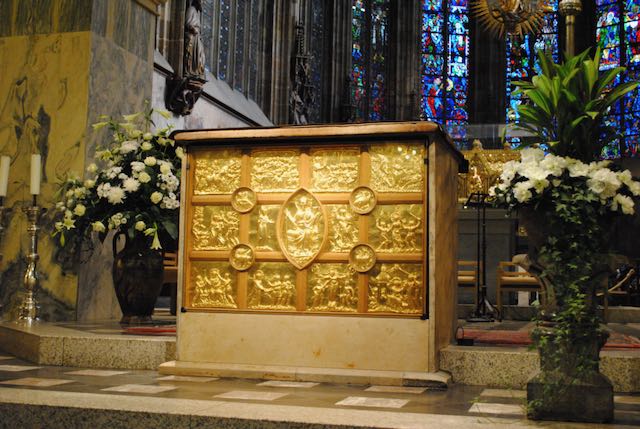
Photo: Aachen (Aix) cathedral choir, © 2014 Honoré Dupuis

Leave a Reply