
“I was stubborn like that, refusing to let my heart redefine how I operated. Looking back, there is a part of me that wants to replace the word ‘stubborn’ with ‘reckless’; there are many things I would do differently now, but what good does it do to retrace your steps? Sometimes you simply do the things you do, and it doesn’t necessarily help to pick on the “old you” by proclaiming how smart the new you is.”
― Dee Williams
“No man ever steps in the same river twice, for it’s not the same river and he’s not the same man.”
I visit memory lane often, on the spur of the moment, sometimes pushed by a sudden reflection on a past event, a sound, a smile, or a scent, from nowhere. Memories, old photos, written bits and pieces, sometimes revisited, less often “edited” without a precise goal to be achieved. But there have been instances when I did wish to go back in time, to “retrace my steps”, not to find lost keys, or an elusive book I was sure I had (but where?), but to rediscover myself, in some way seeking the human being I once was. This is usually unsuccessful. And I have wondered “why”?
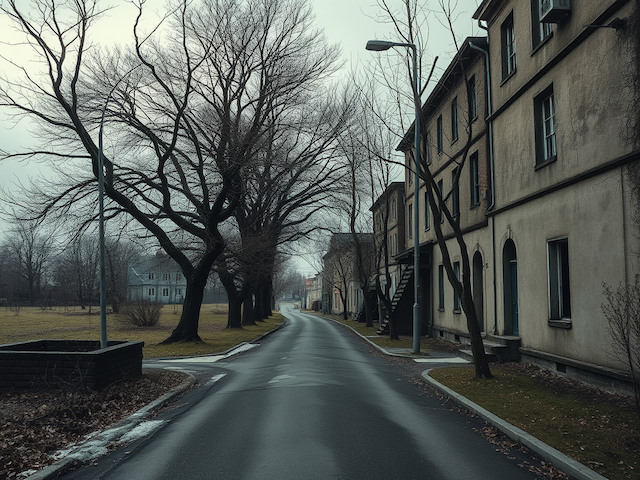
Recently we went back, for a few days, to a city where we lived for nearly five years, to revisit places we’d loved, to walk through streets we had “adopted”. It was in March, the weather was mostly grey, as it often is there, at the time of the year. Shops we loved had closed, part of the city was neglected, pavements covered with rubbish, a disgrace, we thought. Later we talked about it, and the word that came to mind was entropy. It’s a fact: the small paradise we knew, the tree-lined street we lived in, none of this exists anymore: it’s gone, through “renovation”, or “gentrification”, or any random idiocy promoted by local “politicians”. Concrete crumbles, bridges collapse, “slums” are eradicated, streets are renamed (is that a way to erase the past?)
I asked the Britannica chatbot this question: “Is entropy the reason why we cannot ever retrace our steps?”. This is the reply:
“Entropy is related to the second law of thermodynamics, which says that spontaneous change in an isolated system always goes in the direction of increasing entropy. Entropy is a measure of a system’s thermal energy that is not available for doing useful work. It is also a measure of the molecular disorder, or randomness, of a system.
All spontaneous processes are irreversible, and entropy in the universe is always increasing, which means that more and more energy becomes unavailable for conversion into work.
Entropy Increase and the Arrow of Time
The inevitable increase of entropy with time for isolated systems provides a direction for time. The second law of thermodynamics is statistical. It has no meaning at the level of individual molecules but becomes essentially exact for the description of large numbers of interacting molecules.
Retracing Steps
The idea that a system cannot spontaneously become better ordered but can readily become more disordered appeals to one’s experience. When a system fluctuates into a state of lower entropy, the entropy will increase again immediately.
It is possible for a part of a system to decrease in entropy at the expense of at least as great an increase in the rest of the system.”
I am resisting the temptation of giving up on my literary attempts to “revisit the past”. But am I right? Are we just a “large number of interacting molecules”?
Leave a Reply