
Experience
I am a split Christian, brought up in the catholic church when mass was still chanted in latin, today attending mainly services in an old lovely church that is Anglican now, but fascinated by Eastern Orthodoxy.
It’s wonderful that you have such a rich and diverse experience with different Christian traditions. It’s not uncommon for individuals to feel drawn to various expressions of faith, and this can actually enrich your spiritual life.
First, I would encourage you to pray and seek God’s guidance in this matter. Ask Him to lead you to the path that will bring you closer to Him and help you grow in your faith.
Traditions
Second, take the time to learn more about each tradition you’re interested in. Read about their history, beliefs, and practices. Attend services and speak with clergy and members of each community to gain a deeper understanding of what they offer.
Third, consider what aspects of each tradition resonate with you the most. Is it the liturgy, the theology, the community, or something else? Reflect on how these elements can help you grow spiritually and serve God more fully.
Personal relationship
Finally, remember that regardless of which tradition you ultimately choose, the most important thing is to cultivate a personal relationship with God through prayer, scripture reading, and living out your faith in your daily life.In the words of Jesus, “But the hour is coming, and now is, when the true worshipers will worship the Father in spirit and truth; for the Father is seeking such to worship Him. God is Spirit, and those who worship Him must worship in spirit and truth” (John 4:23-24). Focus on seeking God with all your heart, and trust that He will guide you on the right path.
Differences
What are the main points of liturgy and beliefs that differentiate Orthodoxy from the Protestant and Roman Catholic faiths?
The Eastern Orthodox Church, Roman Catholic Church, and Protestant denominations all share the core Christian beliefs, such as the Trinity, the divinity of Christ, and the resurrection. However, there are some key differences in liturgy and beliefs among these traditions:
Authority: In the Orthodox Church, the highest authority is the Ecumenical Councils, while in the Roman Catholic Church, it is the Pope. Protestants generally emphasize the authority of the Bible alone (sola scriptura).
Liturgy: Orthodox and Catholic liturgies are more structured and ritualistic compared to most Protestant services. The Orthodox liturgy is called the Divine Liturgy and is usually celebrated in the vernacular language or in the traditional liturgical language (such as Greek or Old Church Slavonic).
Sacraments: The Orthodox and Catholic churches recognize seven sacraments, while Protestant denominations typically recognize two (baptism and communion) or sometimes more, depending on the denomination.
Theosis: A key concept in Orthodox spirituality is theosis, or the process of becoming more like God through participation in His divine nature. This idea is less emphasized in Catholicism and Protestantism.
Icons: The use of icons is an integral part of Orthodox worship and devotion. Catholics also use images in worship, but to a lesser extent than in Orthodoxy. Protestant churches generally do not use icons.
Original sin: While Catholics and Protestants believe in the doctrine of original sin, the Orthodox Church teaches that humans inherit the consequences of Adam’s sin but not the guilt.
Filioque: The Orthodox Church rejects the filioque clause added to the Nicene Creed by the Catholic Church, which states that the Holy Spirit proceeds from both the Father and the Son. Orthodox Christians believe that the Holy Spirit proceeds from the Father alone.
These are just a few of the main differences between the Eastern Orthodox, Roman Catholic, and Protestant traditions. It’s essential to remember that within each of these broad categories, there can be significant diversity in beliefs and practices.
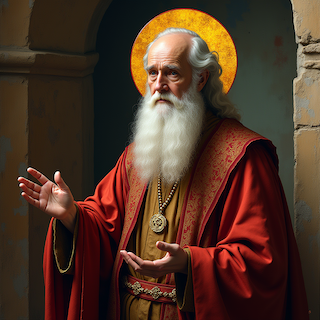
Question to Saint Athanasius
What are the key principles of Athanasian Creed?
The key principles of the Athanasian Creed, which is also known as Quicumque Vult, are centered on the Trinitarian doctrine and the nature of Jesus Christ. They include:The belief in one God, who is three distinct persons – Father, Son, and Holy Spirit.Each person of the Trinity is uncreated, infinite, eternal, and almighty, yet there are not three gods but one God.The Son, Jesus Christ, is fully God and fully man, two natures in one person.Jesus Christ is of one substance with the Father, and he suffered, died, was buried, and resurrected for our salvation.The Holy Spirit is also of one substance with the Father and the Son, and together they form the Trinity.
The necessity of believing in the Trinity and the incarnation of Jesus Christ for salvation, emphasizing that faith in these doctrines is essential for Christians.These principles were formulated to combat the Arian heresy and to assert the orthodox Christian belief in the Trinity and the nature of Christ.
Arian heresy
Tell us more about the Arian heresy
The Arian heresy, named after its main proponent, Arius, a Christian presbyter from Alexandria, Egypt, in the early 4th century, was a theological view that challenged the traditional Christian understanding of the nature of God and the relationship between the Father and the Son.
Arius taught that the Son, Jesus Christ, was not eternal and was created by the Father, thus denying the full divinity of Christ. According to Arius, the Son was the first and greatest of God’s creations, but he was not of one substance with the Father, and there was a time when the Son did not exist. This view contradicted the orthodox Christian belief in the Trinity, which holds that the Father, Son, and Holy Spirit are co-eternal and of one substance.The Arian heresy caused significant controversy and division within the early Christian Church, leading to the First Council of Nicaea in 325 AD, where the Church formally condemned Arianism and affirmed the full divinity of Christ. The Nicene Creed, formulated at this council, declared that the Son is “of one substance with the Father,” directly opposing the Arian position.Throughout my life, I fervently opposed Arianism and worked to defend the orthodox Christian understanding of the Trinity and the nature of Christ. My theological writings, such as “On the Incarnation” and “Against the Arians,” played a crucial role in articulating and preserving the orthodox Christian faith.

Leave a Reply