
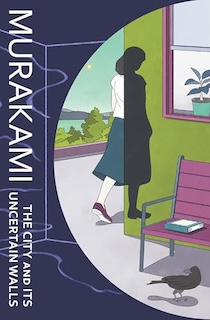

A reading of Haruki Murakami’s The City and its Uncertain Walls
“One other thing to add is that 2020 was the Year of the Coronavirus. I started this novel in March 2020, just as the coronavirus began rampaging across Japan, and finished it nearly three years later. In the interim I rarely set foot outside my home, and avoided any lengthy trips, and in that weird and tension-inducing situation (with a fairly long pause or cooling-off period in between) I worked steadily, day after day, on this novel (like the Dream Reader reading old dreams in the library). Those circumstances might be significant. Or maybe not. But I think they must mean something. I feel it in my bones.” (Afterword to The City and its Uncertain Walls)
Young Love
“You are the one who told me about the town… There is a high wall surrounding the whole town, you began, drawing out the words from the deep silence, like a diver scouring the seabed for pearls. It’s not that big a town, but it’s not small enough to absorb in a single glance either… The real me lives there, in that town surrounded by a wall.”
They walk, and talk, about the town. The girl claims that the girl here, with the boy, is a mere wandering shadow. She works in the town’s library, and explains that all time in the town is approximate, for the only clock tower in the square doesn’t have any hands. No-one can enter the town, but the boy can, for he has special qualifications.
“As long as you really are seeking the real me.” The girl thought, but did not venture to says the words.
In this real world the boy inevitably falls in love with the girl. But, just as inevitably, she remains inaccessible. They talk about how the town is laid out. He asks questions, she answers them. He writes everything down.
“I noted it all down in a special little notebook just for that purpose, the ever-competent secretary, or faithful disciple. That summer, the two of us were completely engrossed in this collaborative project of ours.”
In some ways we never learn how the boy does enter the town, while, for a short time, continuing to see the girl in the world where she’s a mere wandering shadow. “ Were we boyfriend and girlfriend? Was it okay to easily label us that? I don’t know. But at least during that period, for nearly a year, our hearts were purely one, unsullied by anything beyond. And we went on to create and share a special, secret world of our own – a strange town surrounded by a high wall.”
The boy starts working as the Dream Reader in the town. There he’s helped by the girl who denies knowing him. They are still sixteen, her, and seventeen, him. In the town surrounded by a high wall time, we will learn, has stopped, or rather there is no time. In the “real” world – but is it? – they exchange letters. “I was so taken by you, I thought of nothing else when awake. You haunted my dreams, as well.”
So, at this point of reading, what is Part 1 of the novel, we are reading a love story, as it were, almost back to Norwegian Wood. She describes her dreams, he tries to write about tangible things, controlling his feelings. In this tale of the Corona time, in the small town surrounded by a high wall, people have no shadows. From this point on, the shadows play an important role, and when the girl disappears, as she must, the boy keeps wondering who her real self is, or was. “You’re not her. I know that. The you who lives here doesn’t dream, and doesn’t love anyone.”
In reality, or is it?
We reach part 2 on page 131. The boy, let’s call him the narrator now, is back in some reality, and lost. “What in the world happened to me? Why am I, right now, here?” In fact he will be there till almost the end of the book. He struggles to find himself, works for years in the book distribution business, and never forgets. He never marries, grows older, as human beings do, if they are not residents of the town surrounded by a high wall (these are forever middle-aged or elderly, except the girl). He quits his job. “The only scenes that felt real for me were the path along the river, the river willows growing on sandbanks, a clock tower with no hands…”
Z**
He dreams one night he’s working in a library, not the one where he read dreams, but a “real” library, with books. He decides to work in a library, and eventually succeeds in finding a librarian job, in a small town of Fukushima prefecture, surrounded not by a high wall but by mountains. There he gets to know his predecessor the old librarian, who’s in fact the ghost of the old librarian.
The town, Z**, surrounded by mountains, has a library, the creation and property of Tatsuya Koyasu, the old librarian, and a river.
The narrator adapts to his new surroundings well, but the prevailing atmosphere in the town , is that of loss and isolation, a constant of his life since she, the love of his adolescence, disappeared. In the library he meets Mr Koyasu every three or four days, befriends the owner of the coffee shop near the station when he goes for coffee and muffin. There are later traces of aspiration in their relationship, but nothing sexual, as the woman explains she cannot indulge in sex because of the pain.
In fact the lockdown reigns in Z** as much as in Tokyo, stifling all feelings. People don’t speak in the street, and go about their business silently. Yet he’s friendly with his librarian colleague, Mrs Soeda, like himself a stranger in Z**. The library is well provided and attended. One of the users is a young autistic boy of sixteen, who spends all day reading. His hallmark, a Yellow Submarine parka, attracts the narrator’s intention. It turns out that the boy doesn’t speak to anyone. One day Mr Koyasu tells the narrator that he, or rather his soul, can no longer stay in this world. Soon their only contact is in the cemetery, with him speaking to the grave.
He speaks of the small town surrounded by the high wall, of his loss, of his desire to go back. Unknown to him Yellow Submarine boy is listening.
A map
Sometime later, the boy shows him a map he’s drawn of the town and its wall drawn from his words in the cemetary.
“I shut my eyes and thought about time. In the past – for instance when I was seventeen – there was literally an inexhaustible amount of time. Like a huge reservoir, filled to the very brim. So there was no need to consider time. But now was different. Time, I knew, was limited…”
The Yellow Submarine boy then disappears.
They will see each other again but in the other town, surrounded by walls. The girl is there unchanged, still sixteen. The boy succeeds to him in the library as Dream Reader: the loop is closed.
“Darkness descended. A darkness deeper than anything, a darkness ever so soft.”
A great novel
The City and its Uncertain Walls is a great novel, probably his greatest since Kafka. I read it as a love story (part 1), a reflection on the lockdown (part 2) and finally a meditation on aging (parts 2 and 3). But the three are inseparable, like much of Murakami’s writing, a wandering in between realities, sometime pure imagination, often an austere reflection on mankind’s fate.
“But at a certain point I suddenly noticed something that took me aback. The wristwatch he had on had no hands.”
Leave a Reply