
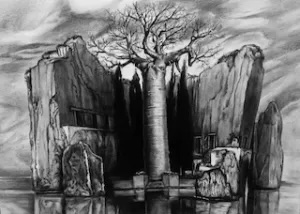
Candelabra
The island is there, the central tree standing up like a candelabra. The artist said it’s the island of the living. Are we to believe her words? Browsing through her work, one reads an evolution, from men hate to, dare I say, worship of the phallus.
What are we to say about the island? Is it a symbol, a salute to Boeklin?
This is what I wrote then:
Serenity
Composure: Serenity allows you to remain composed and calm even in the face of adversity.
Calmness: Serenity is characterized by a sense of calmness, which helps to reduce feelings of anxiety and stress.
Peacefulness: Serenity is a peaceful state of mind, free from turmoil and chaos.
Inner Peace: It is often associated with a deep sense of inner peace that can be achieved through various practices such as meditation, mindfulness, or simply spending time in nature.”
That will do. To rephrase, Toteninsel is a dream of inner peace, as the dreamer knows that his time is getting closer, and wishes to be free of anxiety and fear.
Death and mortality
“Death and Mortality: Böcklin’s work often centered around the theme of death and mortality, as seen in his famous series “Isle of the Dead”. This obsession is hardly surprising, considering he had lost five of his eleven children in infancy, and had had to flee cholera epidemics on two separate occasions.
Symbolism and Allegory: Böcklin’s paintings often featured symbolic and allegorical elements, drawing inspiration from mythology, literature, and his own imagination. His use of bold colors, dramatic lighting, and mysterious settings created a sense of intrigue and mystique.
Mythology and the Occult: Böcklin’s work was influenced by mythology and the occult, as seen in his depiction of otherworldly beings, mysterious places, and dark allegories. His paintings often featured fantastical and symbolic elements, which added to their mystique and allure.
Mystery and Intrigue: Böcklin’s paintings often created a sense of mystery and intrigue, drawing the viewer in with their enigmatic and dreamlike atmosphere. His use of symbolism and allegory added to the sense of mystery, making his paintings open to interpretation and interpretation.
These themes and motifs are evident in his most famous work, “Isle of the Dead”, which has been reproduced five times before he finished with the theme.”
Isle of Life
Isle of Life [1888]

“This painting was probably created as a contrast to the painting “Isle of the Dead”. If “Isle of the Dead” is sombre, with few people in sight, “Isle of Life” is bursting with life. In contrast to the rocky “fortress”, we find here blue skies, abandoned and diverse vegetation, people rejoicing in the background and white swans swimming in clear waters (swans symbolising the partnership with the spiritual world, as well as love and knowledge beyond that of human understanding).
The painting evokes feelings of joy, tranquillity and happiness, but, probably at the expense of embracing dark spiritual forces, as seen by the mermaid having her arms around the disturbing-looking merman and by the sinister shadowy couple that can just be seen beyond the hill of the island. The painting is housed in the Fine Arts Museum in Basel, Switzerland.”
Picture: Emi Makida
Inspired by FOWC
Leave a Reply