
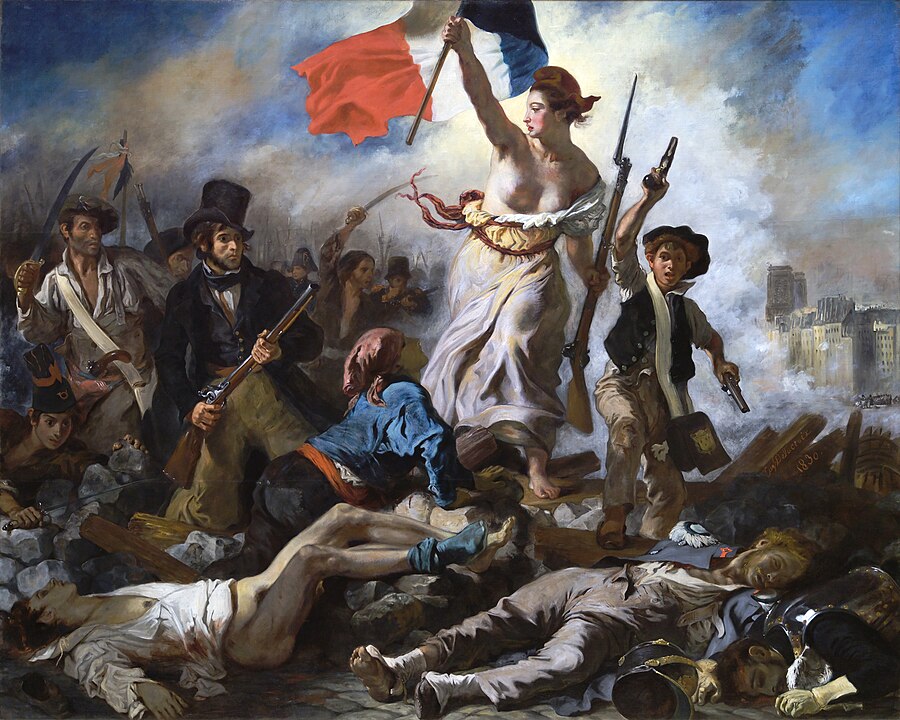


Picture: La Liberté guidant le peuple – Eugène Delacroix – Musée du Louvre Peintures RF 129 – après restauration 2024
What is Freedom?
This is a big word, one that can be associated with the individual, but also with a group, a community, a country. History is full of both interpretations: freedom to gain independence, but also for those of us, still living in a spiritual world, poets, monks, soldiers, this blogger, freedom to contemplate, freedom to pray, and practise our faith.
In the strict materialist view of the world, freedom may be synonym with liberty, as in Delacroix’ painting, “la Liberté guidant le Peuple”, a snapshot of, I think, the 1830 revolution. In this political sense, freedom is freedom to enjoy one’s rights as citizen, which also means abiding by one’s obligations. What better symbolism of this concept of freedom than the maxim of the French Republique: “Liberté, Egalité, Fraternité”? Those words, in this context, only have a political meaning, and may not correspond to everyone’s perception of the living reality.
Fairness and Freedom
For example, writing about Fairness, the Russian philosopher Ivan Ilyin (1883-1954), asserted:
“Every one of us desires fairness and asks that he be treated fairly; every person complains of all sorts of possible injustices inflicted on his person, and begins to interpret the idea of fairness in such a way that is obviously unfair to others. He becomes convinced that his interpretation is is correct, and that he treats others “with complete fairness” but never will he admit that others are outraged at his “fairness” and feel mistreated and neglected…
The French Revolution of the eighteenth century hailed and distributed the harmful preconception that people are “equal” from birth or nature, and that subsequently everyone must be treated “equally”. This preconception of natural equality is the main obstacle towards a resolution of our main problem [that of fairness, but arguably also that of “freedom”], for the essence of fairness lies specifically in an unequal approach to unequal people.”
In a spiritual sense, freedom is freedom to contemplate, admire the work of the Creator, and worship the Creator, Supreme Being or God. The expression of this worship in Christendom was, still is in spiritual countries, the cathedral, dedicated to a Saint or Martyr. This meaning of freedom is personal to each human being, whatever his/her position in society: it is free from strictly political considerations, at least beyond the right of each human being to chose their faith, and the way they practise worshipping the Creator.
Materialistic values
Indeed imposing political considerations, arising from materialistic values or dogma, are the opposite of that definition of freedom. The examples of the various revolutions from 1789 to 1917, amply show the fallacy of attempts to impose a preconception of freedom or equality outside the spiritual domain. The current example of constant violations of freedom of expression, at the same time as its proponents claim being defenders of “democracy”, is self explanatory.
Freedom of expression, freedom of worship, freedom from coercion and artificially imposed pseudo “values” are for this writer, what the word “freedom” means. Within this, free people must uphold the freedom to write and publish, without being censored or harassed by the hideous puppets of political correctness, of various persuasions.
In conclusion, true freedom cannot be dictated by political agendas or materialistic values. The historical revolutions of the past serve as a reminder of the futility in forcing a preconceived notion of freedom or equality. The alarming and persistent violations of freedom of expression in our present time only reinforce this understanding. Real freedom lies within the spiritual domain, independent of external impositions.


Leave a Reply to camilla wells paynterCancel reply