
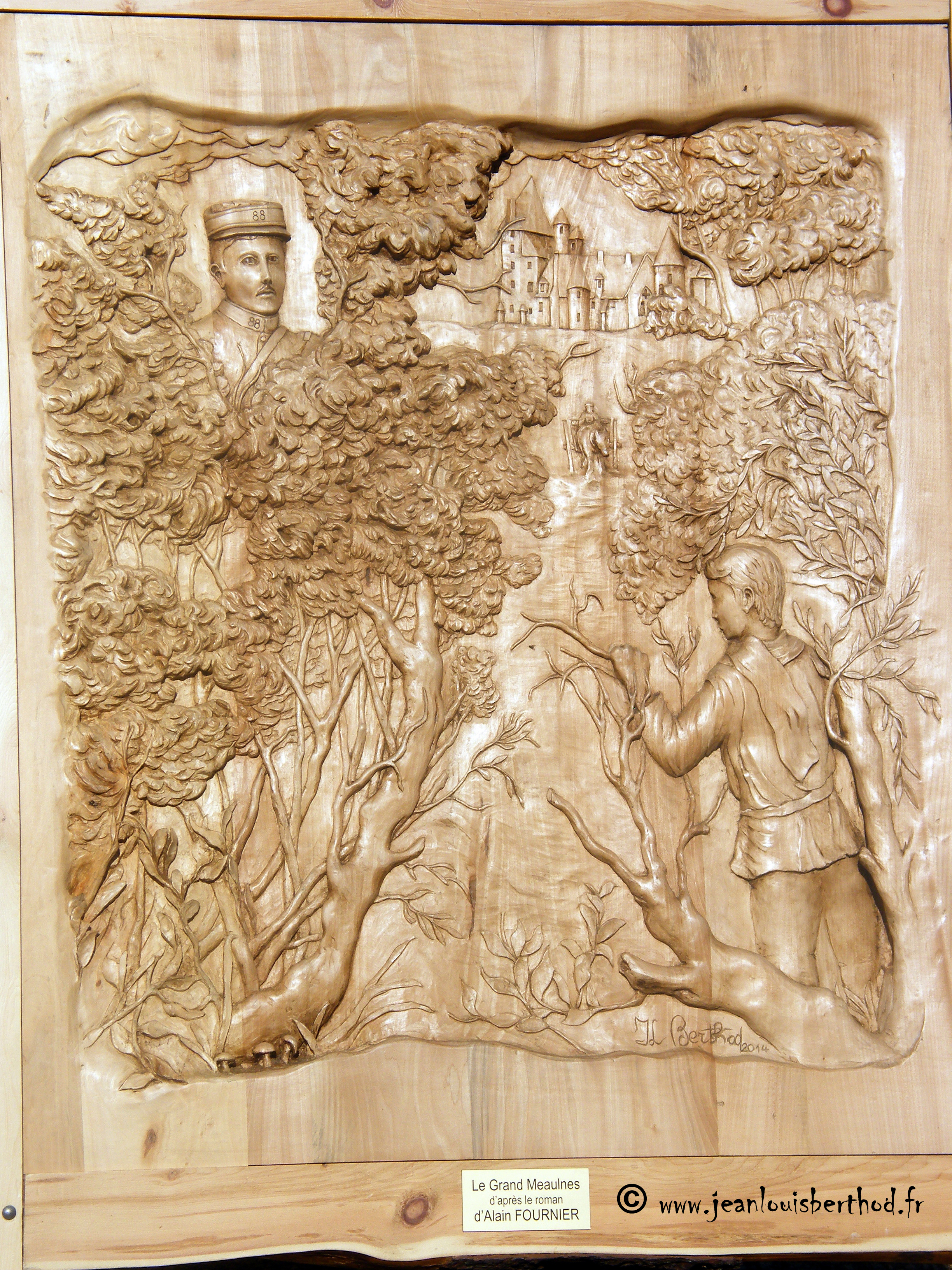


Picture: Le Grand Meaulnes of Jean-Louis Berthod, French sculptor of Albens, Savoy. Sculpture made in lime-wood (130 cm x 140 cm) in 2014.
Youth, Alain Fournier
Youth is, at the same time, a reality and a mystery. To help us to explore this, some books are thresholds, from this to another world, or from this age to another time, here, Le Grand Meaulnes is a gateway to this mysterious transition from childhood to young adulthood, adolescence. The setting, in the old region of the Sologne, a wooded area of lakes and wonderful colours, south of Orleans, and the style of the novel have made it since his publishing in 1913, a favourite read for many people, writers, artists, writers. Sadly his readers never had a chance to speak to, write, or even think of the author, Alain Fournier, who was killed in the first month of the Great War.
The story is relatively simple, the narrator being at first an observer, only emerging from childhood, but soon an actor in the drama that unfolds, as his friend, Augustin Meaulnes, meets the love of his life, only to lose her almost immediately. The encounter is shrouded in romantic lore, an old house, in the golden autumn of the Sologne, a beautiful and secretive young woman. If you haven’t read the novel, then do, you won’t forget it easily.
Youth, threshold of love
I definitely won’t spoil it for you. The (short) life of the author, his short meeting with the lady who later would inhabit his novel, is also worth reading about (at this stage I am only aware of the excellent English Wikipedia entry, and of course the work in French of the Rivière-Fournier Society).
For what a contemporary writer thinks of the novel, see Julian Barnes’ article, written after he re-read Meaulnes in his sixties. What do I like in this nove. First of all when I first read it I must have been of the age of the narrator, at the beginning of the book, not quite sixteen-year old. I missed a few things which I picked up later when I read it for the second time, when I was in the army, more or less at the same age as Fournier. This is an intensely literary work, in the sense of the style, well beyond the average production of the time, if we exclude Proust. Had he lived Fournier may well have equalled Proust, in his art of the French language.
A thousand questions
However what makes the book unique for me, is the extraordinary clarity over the mystery of the transition from childhood to young adulthood is exposed. The plot may be full of shadows and sadness but what prevails is the sheer limpidity of that strange phenomenon: how we transform from an innocent child to a complicated, vulnerable, full of desires and even violent young adult. The book is about youth and its mysteries, about the never to be found again search, for each one of us, in its meaning.
I would love to speak to Fournier, I have a thousand questions. He too was an anglophile, as Barnes recalls. He’s one of a very small club of writers who for me are French literature (for what it is worth, Montaigne, Stendhal, Dumas père, Proust, Camus).
Biography (in French)
The novel “Le Grand Meaulnes” by Alain Fournier is a gateway to the mysterious transition from childhood to adolescence, set in the enchanting region of Sologne. The plot revolves around love and loss, with the protagonist navigating the complexities of youth. The book’s clarity in exploring the transformation from innocence to complexity makes it a unique literary work.
Leave a Reply to Hesitant Self 76 – Glass-and-SandCancel reply