
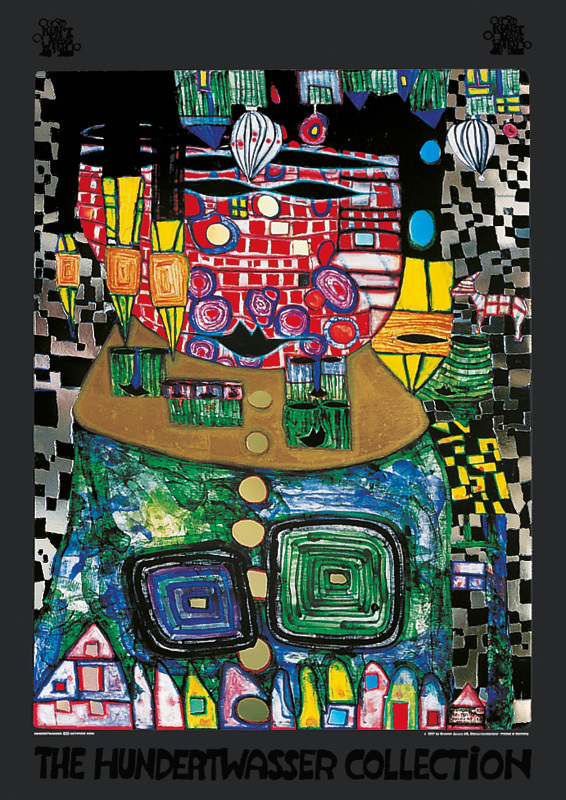

Picture: Hundertwasser Antipode King
For the first time the voice he heard, in his sleep, was not Melissa’s. The woman introduced herself as Gabrielle, Melissa’s teacher, and proceeded to explain where he would find her, in clear, geographical precision. She was courteous, but she left no doubt that he was expected to go. The message was delivered without preamble, as a matter of fact. That night Melissa did not talk to him. But she had previously said she’d wanted him to meet Gabrielle.
The date was three days hence, and he wanted to think about it, to discuss it with Sarah. Why was he meeting the teacher before the pupil, or was the pupil attending too? He was intrigued, a little excited, as his mind considered all the weird possibilities. If the whole story was a hoax he might discover who was at its origin. He may even get a glimpse of his friend, or someone related to her. He thought of the avatar – was there another way to describe that vision? – that his sister Jane had met on Chi. What computer wizardry had created that encounter?
Over the following three days, he worked and trained. He was reading The Passage, a tale of human madness and of the destruction of America. The book reminded him of The Stand, perhaps his favourite novel of the last thirty years. In The Passage, the character of Amy, the Girl from Nowhere, and ultimate saviour of mankind, was immensely attractive to Julian. As in The Stand, the primary cause of the disaster was military delusion and political ineptitude, a cocktail he recognised in his own country at the moment.
The night before the meeting, which was set in the evening at eight, Sarah and Julian talked about what they knew so far. Melissa, a friend from his school days, or someone pretending to be Melissa, had contacted him and continued to communicate with him, although so far never in person. Jane had seen someone claiming to be her, in a virtual world where Melissa had invited Julian. Through her Facebook page they knew – or were led to believe – that Melissa had been murdered some twenty years ago, which would make Melissa a ghost, or a liar? Yet Julian had been given detailed information, in his dreams, about Melissa’s studies and progress in mathematics and physics. Sarah thought that if Julian was to meet anyone, it would be whoever was behind the “tale” of Melissa. She wanted to play down the possibility of her husband meeting the actual Melissa.
Julian agreed that the the most probable outcome was that a friend, or relation, of his dead friend would explain why and perhaps how he had found himself the target of the story.
The following day, he stayed at home, reading and meditating until the evening. Before leaving the house, he dressed as he thought suited to the chilly walk that awaited him once he left the underground. The part of the city Gabrielle had indicated was not known to him.
He got off the tube at an unknown station. The streets were crowded with late shoppers. The air was chilly and damp: he was pleased to be wearing his heavy parka and warm walking boots. He walked along the main street for half an hour, aware of the mix of ethnic shops and suburban squalor. The area had not changed much since the last war. A home for newcomers, from far-away war-torn corners of the world. He suddenly thought of the evacuation of Cincinnati, as described in The Passage.
As he was instructed he turned off into a quiet side street, which after two hundred yards exhibited a very different landscape of narrow town houses, all evidently very old. He walked past a long brick wall with overhanging branches of yet older trees. It was a very strange contrast with the high street he’d just left. After ten or fifteen minutes the street appeared to narrow into a medieval looking lane, with a cobbled surface.
The night grew darker, and the street lights were dimmer and far between. He looked for the number plate of the house. He nearly missed it, hardly visible, above the door of the thin facade of a very old house. The enamel of the plate appeared cracked and ancient. The house was in darkness. He used the door hammer – an old brass object polished with age – and knocked twice. The sound seemed to be swallowed by the door. He waited.
There was no-one in the street, and the sky was hardly visible from the threshold of the house. After a few minutes the door opened silently, revealing a dark corridor, and Julian walked in. As he took a few steps along the corridor he knew the door had shut silently behind him: in front of him there was a faint light.
Julian stopped, disorientated, listening to voices that appeared to be coming from inside the house. They were women’s voices, but not words he could understand. Suddenly he was in front of a closed door, with light filtering from underneath. The door opened and a short woman of indeterminate age invited him through:
“Welcome, Julian. I am sorry not to have met you at the front door – you must forgive an old historian, lost in her reveries…”
The lady was smiling, gesturing to a comfortable-looking sofa facing a chimney. A large bay window gave a view of a garden in shadows. A bright wood-fire burned in the chimney. “I am Gabrielle” continued his host. “I am very grateful you could come all the way to our little place. I find it more difficult to negotiate the city at this time of the year”.
She sat on a chair facing the sofa and invited him to make himself comfortable. “Melissa’s making coffee” she said, “or would you rather have tea?”
Julian replied in a shaky voice that coffee was fine. So, was Melissa living here?
Gabrielle’s hair was a soft copper with grey streaks, she wore thick glasses that seemed to protect her clear blue eyes. She was the perfect image of a mature, benevolent academic, or scientist.
“I know you are anxious to meet your friend, and I owe you some explanation. You see, I am very fond of Melissa: you could say I am her adoptive mother, if I may use these words…”
Julian tried to control his nerves. The house was nearly silent, only Gabrielle’s voice, the crackling wood fire, and the sound of his own blood through this body could be heard.
“I hope you have the time to listen to a long story, but tell me if you need a break, just stop me,” she said, looking at him with a gentle and protective look. “I will use some visuals to help you along the way.”
Julian felt he was falling into darkness: the room had dissolved, leaving him in infinite space. He heard Gabrielle’s voice again: “I must first explain who I am and why I am here…”
Space was filled with a majestic view of a galaxy: Julian was trying to recall its name, when Gabrielle’s voice resumed her narrative. The image – if it was that – was a high resolution three-dimensional view of extraordinary clarity. The galaxy was slowly rotating, and bright spots, like explosions, appeared here and there in its midst. “This is where I come from. You call that area M31, or Andromeda. I know you may find it difficult to accept, and I will not try to convince you of anything, yet. But I have to be absolutely honest with you. My species is high on ethics – I think this is the right way to express it…”
The view was changing, homing in on a cluster of five stars. Figures and symbols appeared around one of the stars, and Julian guessed it was some system of coordinates. The depth of the view was staggering.
“This,” Gabrielle said, “is my home star, the equivalent for me of your sun, and as you see the planet system around it is not that different from yours, but there are five stars, you could say, looking after my species.”
Julian was now looking at a long perspective of perhaps twenty smaller bright spots of various diameters, rotating in a complex pattern around the stars. It was a vast planetary system. He wondered if what he saw was a live view. He was no longer questioning Gabrielle’s words.
The image changed slowly, zooming to show a silvery structure, visibly artificial, that reminded Julian of the Peï pyramid in the Louvre’s courtyard in Paris, but this was suspended in space and probably much bigger. “Our species is also strong on engineering, but,” Gabrielle said, “for some time now, we have evolved a collective way of thinking everything. I just wanted you to see one of our early creations. This is quite old, although our sense of “old” is somewhat different from yours…”
Now Julian was looking at a wide sweep of space, and another galaxy, seen from the edge. He gradually realised that this was his galaxy – the Milky Way – seen from space, from a point possibly situated halfway between it and Andromeda.
“Julian: this shows you what you would see, travelling from my place to yours, as we are really neighbours, in cosmic terms. And, yes, the being you see has been visiting your world”.
The view changed to one Julian recognised; it was the solar system, approached through the asteroid belt and Pluto. He saw the rings of Saturn, and Jupiter’s massive bulk, surrounded by the five moons. He was now aware of the extraordinary clarity of the image and wondered about the structure of the lens that had taken the photography or the film.
As if reading his thoughts, Gabrielle continued. “ Those images are simplified, using filters specific for the human sight. I am showing you only a small fraction of the information held on those records”.
The Earth appeared, the familiar blue and white sphere, the liquid paradise of which he was a product. “Now, I suggest we make a pause” said Gabrielle, “as you may have some questions for me.”
He was back in the room. The fire was burning. He said hesitantly: “How long have you been here, on our world?”
Gabrielle’s kind eyes were observed him, before she replied: “I am a recent visitor, a mere five hundred years, but my kind has been observing and studying this world for much longer, since well before you came in.”
With a sinking feeling Julian tried to gather his thoughts. “And how did you come across my friend?”
Gabrielle was hesitant for some time. “Certain views I can show you, but please be patient. Shall we say we have started a journey? I am a historian, as I said to you earlier, when you came in. My job is to gather facts and evidence on human development and evolution.”
Julian was now immersed in an aerial view, as if taken from a helicopter, of a small town. The image was again clear, as if in slow motion. He could see smoke rising from tall chimneys, a river, some old buildings. After a few minutes he realised this was his childhood town, where he and Melissa had lived all those years back. The “camera” zoomed on familiar places. The town main square with the big lions, where the library was. The traffic was light, and Julian saw that the cars were vintage, of his youth: this was a recorded film. Now the film accelerated, with sweeping views taken along narrow streets, as if whoever held the camera was riding through the air, almost touching the walls. He recognised the market place, the small park, and the canal. Tall trees lined the canal: how well he knew this path!
Cold tears ran down his face. The view was now of a small lane narrowly bordered by crumbling walls and badly kept gardens. For some reason the camera showed a corner of the lane, covered with muddy grass and small stones, then froze. He was back in Gabrielle’s room.
“That was where Melissa was murdered” said Gabrielle in a sad and tender voice. “That is where I found her. I was too late to save her, but I was able to save her… memories.”
Julian felt his heart sink into a well of ice and sorrow. “Are you saying that Melissa is really dead?” he managed to ask.
“She died, and she lives again,” said Gabrielle calmly.
Then Julian was aware of a presence next to him, close, on the sofa.
<< Andromeda
>> Gratitude

Leave a Reply to Gratitude – Glass-and-SandCancel reply