
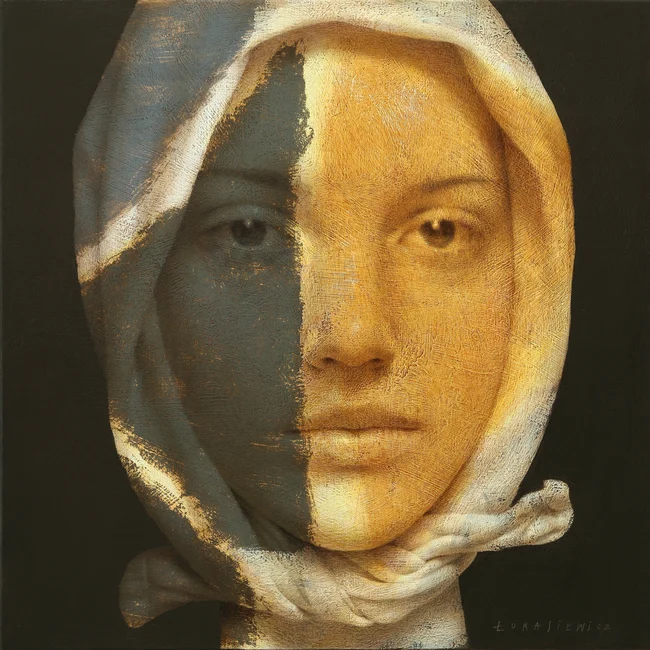

Melissa was talking to him in his sleep about higher mathematics, about the marvels she was learning with her new teacher. Her new interest in physics amazed him. His recollection of her was of a rather simple type of girl. How she had changed… But he was trying to follow. She was so keen for him to understand; she was talking with passion of their future, of the new sense of her own existence, her search for him. She said she would never give him up. She was learning to achieve something: learning to reach him in his world, the world of the living.
He and Sarah had stopped calling her “the ghost”. For his wife, Melissa was his “friend”, or when she felt playful, his “personal alien.” For him she was a new person who inhabited the body – or more precisely – “a” body, for now inaccessible, so much like that of his long-dead school friend.
The girl Melissa of his present had the memories, and much of the spirit, of the other Melissa, but she was a different being. Her difference was her modernity: she was a woman of the 21st, not 20th, century, despite the old fashion style of her page. The “modern” Melissa talked to him in his sleep. She talked but did not appear. She talked to convince, possibly even to educate him. Her sentences were clear, almost luminous. In the morning he remembered everything: what she said about her studies, her teacher Gabrielle, the new chapters of physics and mathematics she had just learned. She seemed to absorb sophisticated mathematical and modern physics concepts and theories that were beyond Julian’s grasp. He did not understand what she was leading at by telling him about her studies, or how it would allow her to “reach” him. Evidently she knew of a link between the two, between her new knowledge and “their” promised intimacy.
However he was no longer anxious about her, nor thinking about his “lost years.” She – or someone – had carefully edited her page, which was now more accurate, and only contained what, to him, looked like original material. It also went beyond their “story,” which, for Julian, was reassuring. He visited her page regularly and had started to write on her wall. What he wrote were comments on what he’d heard in his sleep, reflections on the work she’d told him about. He’d checked some of the articles she’d quoted during their conversations, and it was all genuine. She was reading very recent papers on astrophysics, astronomy, and quantum physics, papers that were far beyond the comprehension of a college girl, or even most graduate students.
He saw her as she was when he left: the same age, same looks, same appearance to the living. And indeed Melissa had confirmed, via her page, that she was as she had always been since her “return”, more than twenty years ago. But then he could not meet her, or at least he could not yet: in his dreams there was, always, an expectation that that “barrier” was not final, that Melissa would find a way.
His rational mind told him it was all a fable, that there was no such thing as coming back from the dead. But the beautiful fact was he did not see it as that. Rather, it was a subtle reincarnation, one of these rare miracles of genetics that, once in a millennium, recreated an identical twin, but remote in time from the sibling. The first Melissa had died. Of that he was certain, but someone who was very much like her had been born, and she was looking for him.
Sarah thought the two of them, her husband and whomever it was who was claiming the persona of Melissa, suffered from a sweet delusion. She did not have a complete theory of what had happened in reality, but she imagined a friend of both of them, perhaps the daughter of one of the “jealous” girls of Julian’s college memories, had somehow picked up Julian’s current whereabouts and created the “myth”. She would be Melissa reconstructed and, ultimately, reincarnated.
Julian shared all his dreams with his wife. Sarah, herself not a mediocre physicist, knew of Melissa’s work and had concluded that the person behind it all was a serious scientist or mathematician. In her view this confirmed the prosaic nature of the phenomenon. Melissa was a real living human being, who was pursuing something that might have started as a joke, or a bet. But Sarah would not speculate where this may lead to: she was just keeping note of what Julian told her about the night’s voice.
Julian was now deep in his work, and was beginning to follow a new routine. His dreams recurred once or twice a week, which was enough to keep his mind awake to Melissa’s progress, without becoming obsessive. Most of his awake time he did not think too much of his friend, but concentrated on his work, and on his wife. Then, one night, Melissa said to him she wanted him to meet her teacher, Gabrielle.
Leave a Reply to An old church – Glass-and-SandCancel reply