
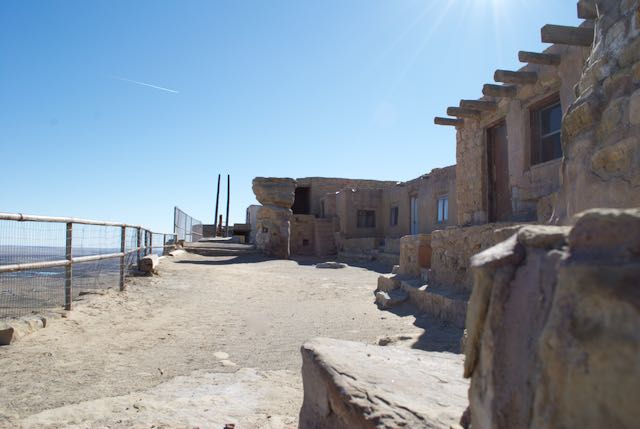

The picture shows the village Sipapuni, the hole in the sky above the lower (third) world.
Introduction
Once you lived on the plain, there you greened the desert, built canals,
grew corn and millet, looked after cattle.
Then the conquistadores came, with their crosses and horses.
You moved up to the mesas, where you could observe their moves, protect your families.
You stayed, you are still there, a small, indestructible people, beautiful, strong and patient.
Black Mesa
“They asked Spider Grandmother, “Are there people in this country? Where can we find someone to talk to?” Spider grandmother answered, “No, in this country there are only the three of us.” Still, whenever Pokanghoya and Polongahoya went on their wanderings they would say to each other, “Let us go to the west, perhaps there is someone living there,” or, “Let us try the valley below the mesa, maybe there is a village down there somewhere.” But wherever they went they discovered nothing but endless land without people.”
(Source: “Here the noted folklorist brings together traditional accounts of epic events and adventures in the life of Hopi clans and villages, from legendary to historical times. The setting of these various adventures and events is not the Southwest as we know it today, but a vast and largely unpeopled wilderness in which clans and families wandered in search of a final living place, and in search of their collective identity. Notes, a pronunciation guide, and a glossary enhance the reader’s appreciation of the text.”)
The Region
“Black Mesa is an elevated, bowl-shaped region (approximately 4,000 square miles) located in northern Arizona. It is part of the Navajo Reservation; a portion of the Hopi Reservation; and some of the Navajo-Hopi Joint Use Area, which is claimed by both the Navajo and Hopi. The region of Black Mesa includes a mesa itself as well as the surrounding sloping hills, canyons, valleys, and four drainages that are tributaries of the Little Colorado River.
This area has been inhabited by Native peoples for over 7,000 years. It is significant to both the Hopi and the Navajo peoples, there are approximately 16,000 Navajo and 8,000 Hopis on Black Mesa. The Hopi reservation consists of twelve villages located on three mesas: First, Second, and Third, all of which are located upon the larger Black Mesa.
The Hopi consider this land sacred and part of their tribal history and origin. For the Navajo peoples, Black Mesa is the sacred female mountain, also known as the Female Pollen Range, and is important to the frequently performed Blessingway ceremony. The Blessingway (Hózhójí) is used to bless the “one sung over,” to ensure good luck, good health, and blessings for everything that pertains to them.
Peabody Coal
Black Mesa is a contested area among Anglo settlers and industrialists, the Hopi, and the Navajo peoples. Despite strong opposition from within and outside their communities, in 1966 the Navajo and Hopi tribal councils sold the mineral and aquifer rights on Black Mesa to the Peabody Coal Company for two million dollars a year. Peabody Coal has been accused of depleting the region’s aquifer; destroying sacred sites; strip-mining; and polluting the area, the Navajo called their actions the “rape of Earth Mother.”
Under federal law PL 93-531, at least 12,000 to approximately 16,000 Navajos were forcefully relocated from Black Mesa, in the largest Indigenous relocation in the United States since the Trail of Tears. The mine was closed in 2005; however, in 2008 Peabody Coal received a permit to open again but were denied by administrative law judge in 2010 for not satisfying the National Environmental Policy Act (NEPA).”
(Source)
Photo: North-Eastern Arizona, small Hopi village on top the Third Mesa © 2016 Honoré Dupuis
Leave a Reply